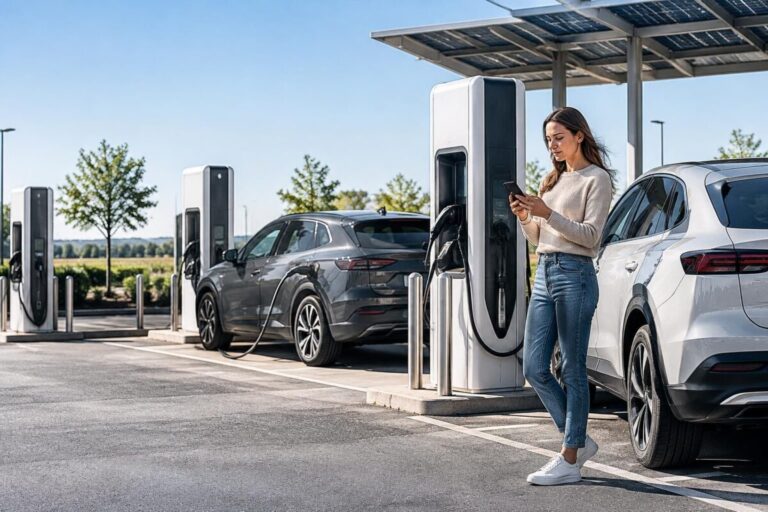
EV models: small battery or regret in 3 years?
Hello, it’s Xérian. A small battery avoids regret if your daily commute fits within its real range, with a margin for cold and detours. If you often do long trips without easy recharging, choose a higher capacity. The right choice depends less on the displayed number than on your routine.
TEST NOW
- Record the distance of your usual trips over a week.
- Identify the long trips you actually take, not just those you imagine.
- Check if you can install home charging or charge easily at work.
- Compare the advertised range with estimates in winter and on the highway.
- Keep a reserve for detours, traffic jams and battery degradation.
Small battery: when the choice stays comfortable
For an electric car used mainly in town and around home, a small battery can be enough. If you travel 30 to 60 km per day, depending on your pace and the model, charging every evening or every two days can be simple.
The situation changes when you frequently drive on the highway or don’t have a regular charging point. A reduced electric range then requires more stops and planning. To compare the trade-offs between a compact format and useful kilometers, consult this note on the compact battery and truly usable range.
The real risk: buying for a routine that isn’t yours
Camille drives 25 km per day and charges in her garage: a small battery suits her daily use well. Her neighbor regularly covers 250 km to visit family and cannot charge at destination; for him, the same car would require more planning.
If you can charge at home and mainly drive locally, a small battery can be a smart choice. If you do many long trips, a larger battery can avoid the constraint—even if these trips represent only part of the year.
Electric range: plan for a margin rather than aiming for exactness
The displayed range does not always correspond to what you get on the road. Cold, speed, heating and the terrain can reduce it; the gap varies by model and situation. A car that just covers your route on paper may therefore require an unexpected recharge in winter.
Battery capacity also gradually loses part of its potential. Fleet studies report average losses around 1.8 to 3% per year depending on the vehicles and conditions observed, but wear is not identical from one car to another and does not necessarily follow a regular path. These averages do not allow precise prediction of your future vehicle’s range.
| Your profile | Small battery | To check before purchase |
|---|---|---|
| Short trips and home charging | Often suitable | Winter range and charging time |
| Long trips occasionally | Possible with planned breaks | Charging network on your routes |
| Frequent highway driving, difficult charging | Risk of constraint | Actual range and charging power |
To understand what matters in the long run, you can also read this analysis on the lifetime of EV batteries. The right benchmark remains a sufficient range for your usual trips, with a reasonable margin.
Battery degradation: what warranties cover
In many European markets, the battery warranty is often 8 years or 160,000 km, with a minimum capacity threshold indicated by the manufacturer. Conditions vary by brand, model and sometimes version: check the contract before signing, especially for a used car.
A drop in capacity does not mean the battery suddenly stops working. It gradually reduces the available range. Replacement cost can be high, but this scenario is not a sufficient reason to rule out a model: also look at the remaining warranty, the health of the battery and the repair options offered.
In everyday use, following the manufacturer’s recommendations is more useful than applying a universal rule. A charge limited to around 80% is often suitable for regular trips, while some LFP batteries can be charged to 100% at intervals defined by their manufacturer. Above all, avoid leaving the battery almost empty or full for long if the manual warns against it.
EV model choice: a three-step method
- Step 1 : estimate your usual distances and distinguish daily trips from occasional trips. Add a margin for cold and highway.
- Step 2 : check where you can charge, how long it takes and whether charging stations are available on your frequent routes.
- Step 3 : compare the purchase price, the warranty, the real range and the resale value. To broaden the comparison, also look at the EV models cheapest to keep.
A common mistake is to buy a large battery “just in case,” then pay more for a capacity rarely used. The opposite also exists: picking the cheapest model without testing its range on the trip to the second home. A few minutes of simulation can sometimes save three years of frustration.
Small battery or purchase regret: the questions to settle
Can a small battery last that long?
Yes, size alone does not determine the lifespan. Usage, temperature, thermal management and charging habits also count. The available capacity will decrease over time, at a rate that varies depending on the model and conditions.
Does home charging change the choice?
Often, yes. Regular charging at home makes a more modest range easier to live with, especially for short daily trips. Without convenient charging, higher range can provide more flexibility.
Should you avoid a used electric vehicle?
Not necessarily. Ask for a diagnostic of the battery health, verify the history and read the remaining warranty conditions. The current range matters more than a general estimate based on age alone.
What margin of range to plan?
There is no universal margin: it depends on the climate, speed and your trips. Make sure that the range in adverse conditions covers your usual travels without mandatory charging along the way.
The best choice isn’t necessarily the largest battery: it’s the one that matches your actual trips, your charging possibilities, and your budget, without forcing you to calculate every kilometer.
Thank you for reading; Best regards; Xérian