EV innovations: solid-state battery or marketing hype?
Hello, this is Xérian. A solid-state battery is a real avenue of innovation, but performance announcements do not yet mean the technology is ready for all cars. To distinguish concrete progress from hype, focus on three proofs: vehicles actually delivered, large-scale production, and verifiable results over time. In 2026, prototypes and pilot projects are advancing, while lithium-ion batteries remain the most widespread solution. For your next electric vehicle, it’s better to compare the models available today rather than wait for a promise with no date or clear price.
TEST IT NOW
-
Check whether the manufacturer talks about a solid-state or semi-solid battery: it’s not the same technology.
-
Look for a delivery date and a specific model, not just a technological announcement.
-
Compare the advertised range with the real consumption on highways and in cold weather.
-
Ask for the price, the warranty, and the battery replacement conditions.
-
For a near-term purchase, compare the available EVs rather than counting on an innovation still in pilot phase.
Solid-state battery: a real innovation, not yet a revolution available everywhere
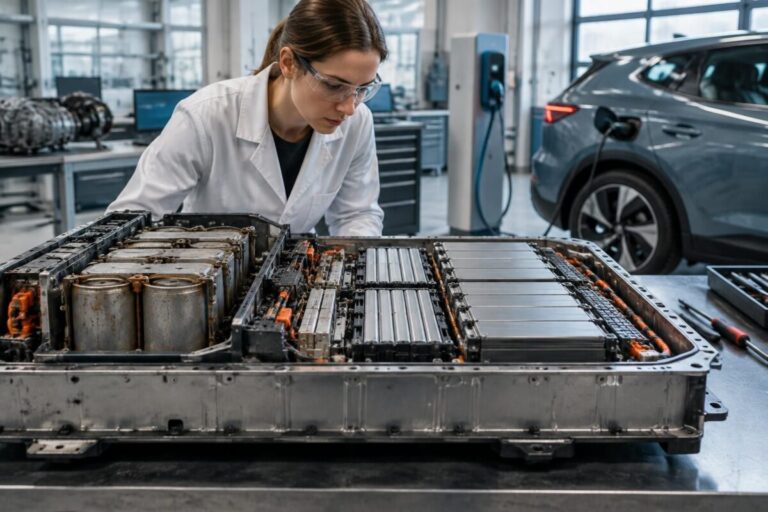
A solid-state electrolyte battery replaces the liquid that carries ions with a solid material, for example ceramic or polymer. This architecture could improve energy density and reduce certain risks related to overheating. But a laboratory cell is not yet a battery ready to equip millions of cars.
Spectacular numbers — strong electric range or very short charging time — often describe objectives, prototypes or particular test conditions. They do not, on their own, tell you what you will get on the road, in winter or after several years of use. To place the announcements in their context, you can read this point on the solid-state battery vs. marketing argument.
Solid, semi-solid: two steps not to confuse
Semi-solid batteries retain a portion of liquid or gelled electrolyte. They may represent a more accessible production step, but they do not correspond to an entirely solid cell. The name used in an advertisement is therefore not enough: you must look for the composition and the announced maturity level.
The decisive point is not the name of the technology, but its ability to operate reliably and repeatably in production. That is where industrialization becomes the real test.
Range, charging and safety: what promises don’t always reveal
Higher energy density could allow storing more energy in a comparable volume or weight. In practice, the range gain also depends on the vehicle, its aerodynamics, the battery size, and how it is used. An announcement of 1,000 km range does not mean that every driver will travel that distance daily.
Battery safety could also improve, notably by limiting certain fire scenarios related to the liquid electrolyte. This does not make a battery immune to damage nor does it remove protection systems. Likewise, very fast charging depends on the cell, the charger, the temperature and the power accepted by the car.
| Criterion | Current lithium-ion | Solid-state battery |
|---|---|---|
| Maturity | Widespread adoption and established production | Prototypes and pilot projects depending on the players |
| Energy density | Current reference, varies by chemistry | Potential for increase; results depend on the cell |
| Charging time | Very variable depending on the vehicle and the charger | Aim for fast charging, not yet a universal promise |
| Cost and availability | Broad choice across several price ranges | Mass production and price yet to be confirmed |
For the buyer, a number is valuable only if it is associated with a clear measurement method and a marketed model. The current buying criteria remain detailed in these questions to check before buying an EV.
How to recognize concrete progress from hype
A precise timeline, an identified factory, and on-road test vehicles are stronger indicators than a flashy presentation. Major automakers and cell manufacturers are exploring several paths: ceramic, polymer, sulfides, or hybrid solutions. None has yet established itself as the sole answer for all models.
An announcement can be sincere and still be distant: between a functional prototype and an affordable car, manufacturing must be stabilized, costs controlled, and longevity validated. To examine gaps between communication and accessible results, also read this analysis of the progress visible to drivers.
Three steps to decide without waiting for a miracle battery
-
Step 1 : define your real needs: miles driven, long trips, home charging and budget.
-
Step 2 : compare the models already sold on real-world range, warranty and charging network.
-
Step 3 : if a solid-state battery interests you, ask for a confirmed commercialization date and verify the specs of the exact model.
If you need to change your car soon, choose based on the performance, price and warranty of available models. If your purchase can wait several years, follow the announcements, but demand evidence of production and delivery before basing your decision on them.
What to keep in mind before buying an electric vehicle
Solid-state battery is not a mere advertising invention: it addresses real technical challenges. But the announced gains in range, charging and safety remain to be confirmed at scale. The best approach is to separate laboratory objectives from the features of a car you can actually buy.
Is the solid-state battery already available in mainstream cars?
It is not yet widely available in mainstream cars. Some semi-solid solutions and some pilot projects exist, but you need to verify the exact technology proposed on each model.
Will a solid-state battery still let you drive 1,000 km?
No. This range corresponds to goals or announcements associated with certain projects. The actual distance will depend on the vehicle, driving, weather and the measurement cycle used.
Should you wait before buying an EV?
Not necessarily. If a current model meets your trips and budget, compare it with other available options. Waiting makes sense only if your purchase is not urgent and if the upcoming announced models truly meet your needs.
How to verify that a technology announcement is credible?
Spot a specific model, a delivery date, independent trials and a detailed industrial roadmap. A promise without these elements remains an announcement, not proof of availability.
Thank you for reading ;Best regards; Xérian