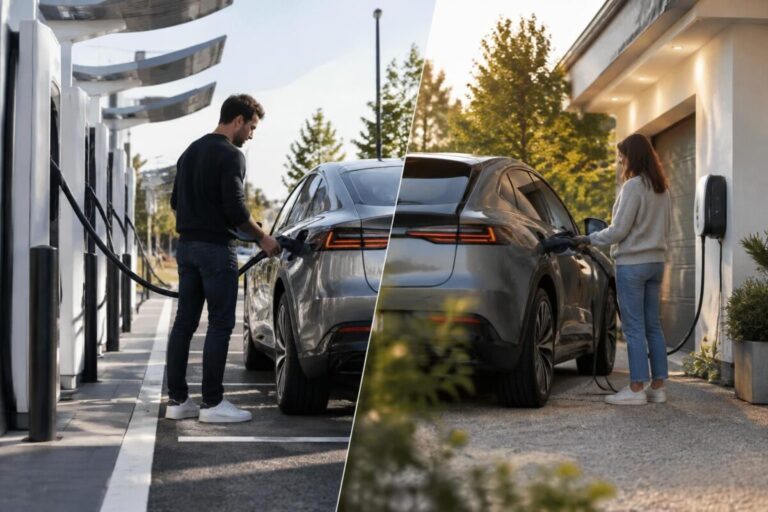
EV charging: do subsidies hide a high remaining balance?
Hi, this is Xérian. Yes, subsidies can leave a high out-of-pocket cost, especially for a home installation in 2026: the tax credit is no longer open to new equipment. Before signing, compare the installation cost, check the available subsidies in your situation, and request a detailed quote. Getting the charging station properly sized matters as much as the subsidy.
TEST IT NOW
- Ask for a quote that separates the charging unit, installation, and any electrical works.
- Check the power available at the distribution board and the type of electrical installation, single-phase or three-phase.
- Ask the town hall, the department, and the region whether any local aid is available.
- If you live in a condominium, check Advenir subsidies and the steps with the building manager (syndic).
- For equipment paid for before December 31, 2025, check whether the old tax credit can still be declared in 2026.
The first trap is to look only at the displayed price. A charging station more powerful than necessary can inflate the bill without meaningfully speeding up everyday charging.
Aid options for charging stations in 2026: what remains accessible
Since January 1, 2026, the tax credit for new installations is no longer renewed. It can however concern the 2026 filing if the charging station was installed and paid for before the end of 2025, subject to applicable conditions: the previous scheme covered 75% of expenses, up to €500 per controllable system.
For a new installation, aids depend mainly on the place and the project profile. In collective housing, the Advenir grant can help fund certain installations, while local public subsidies sometimes exist. A reduced VAT rate of 5.5% may also apply to certain works, depending on their characteristics and the conditions in force.
Do not count on any aid before confirming your eligibility. Rules may vary depending on the dwelling, the type of charging station, and the chosen setup; ask for written confirmation from the installer or the relevant organization.
To compare equipment without paying for unnecessary power, see this guide on the choice of a 7 kW charging station and the risk of poor sizing.
Out-of-pocket cost: calculating the true cost of the installation
The basic calculation is simple: out-of-pocket cost = total cost including tax − confirmed aids. Add to the quote the necessary works, such as upgrading the distribution panel or pulling a longer cable. An announced aid that has not been validated should not be considered as secured.
| Situation | Aid to check | Effect on out-of-pocket cost |
|---|---|---|
| New installation in a single-family home in 2026 | Possible local aids and applicable VAT | The tax credit removed for new equipment does not reduce the bill |
| Condominium installation | Advenir grant, depending on the project and its criteria | The amount depends on eligibility and the chosen quote |
| Charging station installed and paid for before 31 December 2025 | Old tax credit, subject to conditions | Up to 75% of expenses, capped at €500 per controllable system according to prior rules |
| Housing benefiting from a local scheme | Municipal, departmental or regional aid | Deduction possible after confirmation of conditions and payment calendar |
Simple example: for a hypothetical quote of €2,000, if a local aid of €300 is confirmed, the out-of-pocket cost is €1,700. Without validated aid, you should budget €2,000; the actual amount still depends on the works and the situation.
A low quote isn’t necessarily a good deal if safety or electrical protections are neglected. To compare the items, here are the useful benchmarks on the price of a properly installed charging station.
Two quick cases to tailor the charging financing
If you live in a single-family house: request several quotes and check local aids before choosing. Available financing may be limited, so equipment sized to your trips and your electrical installation better protects your budget.
If you live in a condominium: first check the collective connection and Advenir eligibility. Connection charges and cost sharing can significantly change the out-of-pocket amount.
Reduce installation costs without sacrificing safety
A charging station must match the panel’s power, the vehicle’s charging capability, and driving habits. The most powerful model is not automatically the most relevant: if the car charges every night and daily trips are short, a lower power may be enough.
Ask the installer to detail protections, cable length, any control/monitoring and panel modifications. A common oversight is comparing two quotes without checking whether the included electrical works are the same.
Fast charging is not always necessary at home. This point is explained in this guide on choosing between standard charging and fast charging.
Three-step procedure before signing
- Step 1 : record the available power, the type of connection, and the distance between the distribution panel and the planned location. Also note your usual daily driving distance.
- Step 2 : request at least two comparable quotes, with the equipment, installation, protections and any ancillary works clearly detailed.
- Step 3 : verify the aids in writing, then calculate the out-of-pocket cost based on the amount actually confirmed, excluding any aid that is still pending.
This method makes the budgeting for drivers clearer and helps avoid choosing a charging station based solely on the promise of aid. For an apartment project, the steps and local costs are detailed in this guide on recharging in an apartment building and its costs.
Charging financing: questions to verify
Charging financing should be prepared before ordering, as aid can depend on the timing of the work, the dwelling, or the nature of the equipment. A simulation is useful, but only confirmation from the relevant agencies allows incorporating a sum into the final calculation.
To keep an overview of charging-related expenses, you can also consult these benchmarks for planning a more serene charging budget.
Is the tax credit still available for a charging station bought in 2026?
No, it has not been renewed for new installations since January 1, 2026. The 2026 declaration may, however, concern a charging station installed and paid for before December 31, 2025, if the conditions of the old scheme are met.
What aids can reduce the out-of-pocket cost in 2026?
Depending on the project, it may be the Advenir grant for collective housing, local aids, or a reduced VAT applicable to certain works. Eligibility must be confirmed before signing the quote.
How to calculate the out-of-pocket cost of a charging station?
Subtract from the total cost including tax only the confirmed aids. Also include ancillary electrical works, such as an adaptation of the panel or the installation of a longer cable.
Is a high-power charging station still preferable?
No. The useful power depends on the electrical installation, the vehicle and daily trips. A properly sized dimensioning can help avoid paying more for a capacity that is not used much.
Thank you for reading; Best regards; Xérian