Charging stations: French-made and suitable, or too slow to charge?
Hello, it’s Xérian. Charging stations in France are generally well suited to electric vehicles, but charging speed depends above all on compatibility with your car and the power actually delivered. A very powerful charging station does not automatically make charging faster. To save time, check the type of current and the power your vehicle can accept before you stop.
CHECK RIGHT NOW
- Check the maximum AC and DC power your car can accept.
- Check whether the charging station supplies alternating current (AC) or direct current (DC).
- Choose a charging station with power that matches your vehicle.
- On the motorway, look for a fast DC charging station suited to your journey.
- Keep your Type 2 cable in the boot for AC charging stations that don’t have one.
Charging stations: is France’s infrastructure suitable?
Yes, for most uses, but not everywhere in the same way. AC charging stations are suitable for longer stops, while fast DC charging stations are useful when travelling. Infrastructure is improving, but coverage, availability and power vary by area.
The key factor is still the match between the charging station and the car. If your vehicle accepts a maximum of 100 kW DC, a 300 kW station won’t exceed that limit. And if the battery is cold or nearly full, or the station is sharing its power between several cars, charging speed may drop.
For example, Camille stops at a very powerful charging station with a city car limited to a more modest charging power. The car can’t make full use of the station’s capacity: a less expensive, but better-suited, charging station would have been enough. To compare charging options, also check out these tips on fast charging.
AC or DC: why the type of current affects charging speed
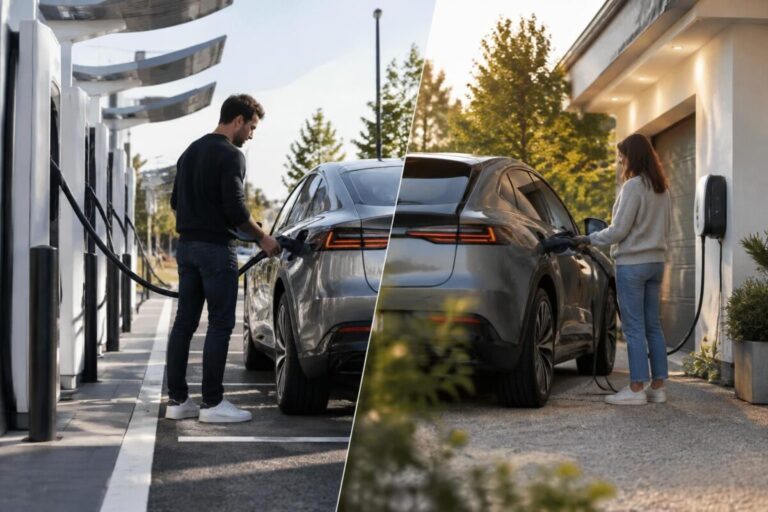
With alternating current (AC), the car’s onboard charger converts the current to power the battery. This conversion often limits charging power. AC charging stations, generally used at home, on the street or in car parks, are convenient when the car is parked for several hours.
With direct current (DC), the charging station does the conversion. Charging can then be much faster, provided the vehicle is compatible. Cables are generally attached to DC charging stations, while a public AC charging station often requires you to bring your own Type 2 cable.
| Charging type | Typical power | Suitable use |
|---|---|---|
| Household or reinforced socket | Low, depending on the installation | Slow charging at home, over several hours |
| AC charging station | Approximately 3.7 to 22 kW | Longer parking periods and daily journeys |
| Fast DC charging station | Approximately 22 to 100 kW | Shorter stops and charging on the go |
| Ultra-fast DC charging station | Approximately 100 to 350 kW | Long journeys, if the vehicle can make use of it |
These ranges are indicative: the power actually received depends on the model, the battery and charging conditions. A charging station displaying a high power rating therefore does not guarantee charging at that speed.
Why does charging sometimes seem too slow?
The power of the charging station is only part of the equation. Battery capacity and technology matter too: a larger battery generally needs more energy to reach the same charge level. The car also limits the maximum power to protect its battery.
Charging speed often drops as the battery approaches a high state of charge. It can also decrease in cold or hot weather, or when the station shares its power between several vehicles. A useful habit: check the power displayed after a few minutes instead of relying only on the figure shown on the charging station.
Two situations for choosing the right charging station
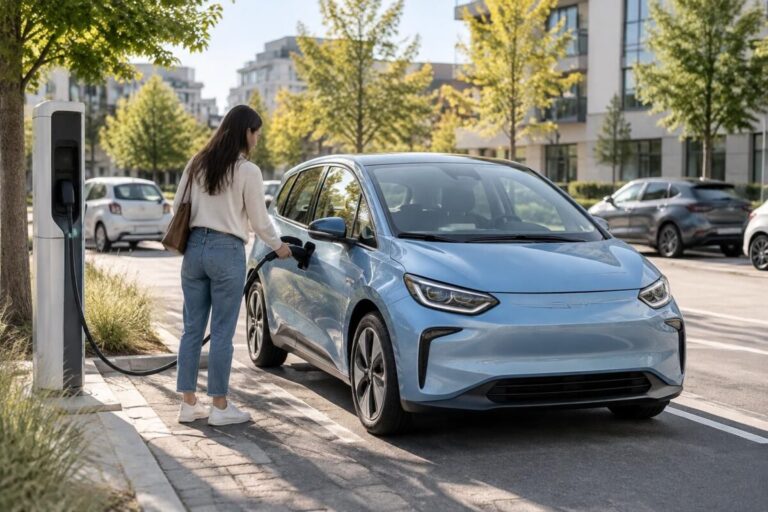
If you’re charging in town or for several hours, an AC charging station is often sufficient. Make sure you have your Type 2 cable and that the power matches what your car can accept.
If you’re setting off on a long journey, choose a fast DC charging station along your route that’s compatible with your vehicle. The Renault trip planner or the MyRenault app can help you find suitable stops. To reduce waiting times, here are also some tips for avoiding an occupied charging station.
How to choose a suitable charging station in 3 steps
- Step 1: check your car’s capabilities. Consult the manual or the vehicle’s screen to find out the maximum AC and DC power it can accept, as well as which connectors are compatible.
- Step 2: compare with the charging station. Use an app or GPS to check the connector type, available power, price and the charging station’s status. For an AC charging station without an integrated cable, bring your Type 2 cable.
- Step 3: start and check the charging session. Pay using an accepted method, plug in the cable, then check the charging station’s screen or the app to make sure charging has started. To stop, follow the displayed instructions before unplugging.
Public charging stations offer different payment methods: bank card, charging card, QR code or app. Keep a backup option, as not all stations accept the same payment methods. For a home installation, you can also consult this guide to the cost of a charging station.
What to remember about charging speed
A well-suited French infrastructure doesn’t mean that every charging station is right for every car. The right choice depends on three things: AC or DC current, the power the vehicle can accept, and the battery’s condition.
For everyday use, slow or AC charging fits easily into a longer parking stop. For long journeys, fast charging saves time when the car is compatible. This match, more than the maximum power displayed, is what makes electric mobility easy to live with.
Does a more powerful charging station always charge faster?
No. The car limits the power it can accept, and the battery, its temperature, its charge level or power sharing can slow down the session.
Can I use a fast DC charging station with any electric car?
No. The vehicle must be compatible with DC charging and have the right connector. Also check its maximum charging power before choosing the station.
Which cable should I bring to a public charging station?
AC charging stations without an integrated cable generally require you to bring your Type 2 cable. Fast DC charging stations most often have their own cable.
Why does charging slow down when the battery is almost full?
The car often reduces power as the battery approaches a high charge level, to manage charging under suitable conditions.
Thank you for reading; Best regards; Xérian