5 Tips for Choosing an EV Model for Range Before Buying
Hello, it’s Xérian. To choose an EV model without regrets, compare its real-world range with your trips, then check charging and the total cost before signing. In 2026, electric car models cater to very different needs: a city car is often enough for urban driving, while long trips require more range. The right choice isn’t necessarily the one with the biggest number, but the one that suits your driving conditions.
TRY IT RIGHT AWAY
- Write down your usual trips and the mileage for a typical week.
- Compare the claimed range with reports of real-world range, especially on highways and in cold weather.
- Find charging stations near your home, at work, and along your usual routes.
- Ask about charging, insurance, and maintenance costs to estimate your budget over five years.
- For a used car, request a battery capacity report and check how much warranty remains.
Electric vehicle range: look beyond the advertised figure
The advertised range is useful for comparison, but it doesn’t predict every trip exactly. Speed, cold weather, heating, terrain, and the load you’re carrying can reduce the distance you travel before recharging.
For everyday use, many models offer around 300 to 500 km of WLTP range, depending on the version. In practice, allow for a margin: on highways or in winter, the range can be significantly lower. So, before buying, start with a simple question: how far do you want to travel without turning every journey into a calculation?
A 40 km daily commute doesn’t call for the same capabilities as regular trips of several hundred kilometers. To better understand the official test figures, see this overview of the gap between WLTP range and real-world range.
Compare models on your usual routes
Before buying, take a test drive on a route that includes, if possible, a stretch of expressway, an urban section, and a hill. Pay attention to energy consumption, ease of driving, and how the displayed range changes. A short drive around the dealership doesn’t always reveal important differences.
If you’re choosing between two battery sizes, don’t automatically pay more for the larger one. A larger battery can be useful for long trips, but it often increases the price and weight. This guide to long-range models and how they’re used helps put that trade-off into perspective.
Charging an EV model: check charging times and access to stations
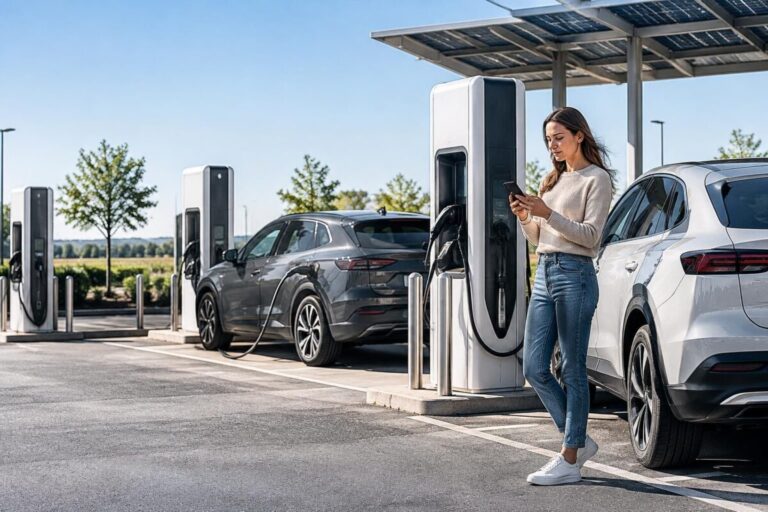
A comfortable range isn’t enough if charging is complicated in everyday life. Check whether you can plug the car in at home or at work, then find out which public charging stations are genuinely accessible in your neighborhood and along your routes.
Charging time depends on the station’s power, the battery capacity, and the charging power the car can accept. A fast charger won’t charge every model at the same speed. Also ask whether the necessary cable is included: overlooking this detail can make your first charging session more difficult.
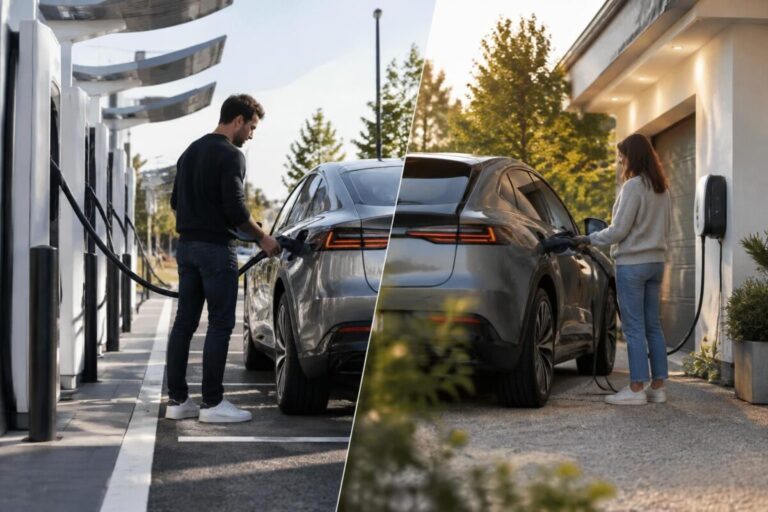
If you have a socket or charging station at home, an average range may be enough for daily trips, since the car charges while parked. If you rely on public charging stations, choose a network that’s convenient near the places you go and check charging compatibility before making your choice.
Electric vehicle comparison: guidance by type of use
The figures below are indicative estimates. The version, temperature, speed, and route can all affect real-world range: always ask for data that corresponds precisely to the vehicle you’re testing.
| Model | Indicative WLTP range | Use to consider |
|---|---|---|
| Renault 5 E-Tech | Approximately 300 to 400 km, depending on version | City, suburban, and regular trips |
| MG4 | Approximately 350 to 450 km, depending on version | Versatile use, with several battery options |
| Peugeot e-308 | Approximately 400 to 450 km, depending on version | Mixed driving and regular trips |
These figures don’t replace a test drive or an estimate tailored to your routes. To decide whether a larger battery is worth the price, compare the extra cost with how many long trips you make each year. This analysis of the cost of a long-range battery can help you assess the trade-off.
Total cost and battery: check expenses before signing
The purchase price doesn’t tell the whole story. Add electricity, insurance, maintenance, any charging station installation, and resale value. Charging costs depend in particular on your electricity rate and the proportion of charging done at home or at public stations.
For a used car, ask for a battery health report, often expressed as SOH. A result of around 80% or higher is a reassuring benchmark, but you should also consider the range you need and the remaining warranty. An independent diagnostic can cost roughly 80 to 200 euros, depending on the provider and the level of analysis.
Check the date of first registration, mileage, and the exact warranty terms. Battery coverage often lasts for several years, but its duration and threshold vary by manufacturer. A properly assessed battery helps ensure that an attractive price doesn’t conceal a range that has become too limited.
Three steps to choosing an EV model with the right range for you
- Step 1: Record your daily trips, occasional journeys, and places where you can charge. Allow extra range for detours and winter conditions.
- Step 2: Select two or three models, then test-drive them on a route similar to your usual driving. Pay attention to consumption, comfort, and ease of charging.
- Step 3: Compare the five-year budget, battery warranty, and likely resale value. For a used car, add a battery diagnostic to the vehicle inspection.
This approach helps you avoid choosing based solely on a spec sheet. Above all, it lets you connect range, budget, and driving habits to a practical decision.
Frequently asked questions before buying an electric model
What range should I choose for daily trips?
First, assess how far you travel each day and your access to charging. A longer range becomes useful if you often make long trips or can’t charge easily.
Does WLTP range correspond to real-world range?
Not always. Speed, cold weather, heating, terrain, and the load you’re carrying can reduce the distance you travel. Use the WLTP figure as a basis for comparison, then check estimates that match your use.
Do I need to install a charging station at home?
It isn’t essential, but a charging station can make charging easier and faster. If you plan to use a standard outlet, have the electrical installation checked and estimate how much time charging will take as part of your routine.
What battery condition report should I request for a used EV?
Ask for a recent SOH report, maintenance history, and details of the remaining warranty. An independent diagnostic provides a more useful measurement than an estimate of the range displayed on the dashboard.
Thanks for reading; Best regards; Xérian